

Courtesy : www.iberdrola.com
Floating solar energy
Solar photovoltaic energy is one of the most important and well-established renewable energy sources. For the past few years, floating solar PV has been gaining ground, which, according to the World Bank, could double installed capacity. At the moment, it has gone from 61 MW in 2015 to more than 3 GW in 2021, with 688 MW added in 2020 alone.

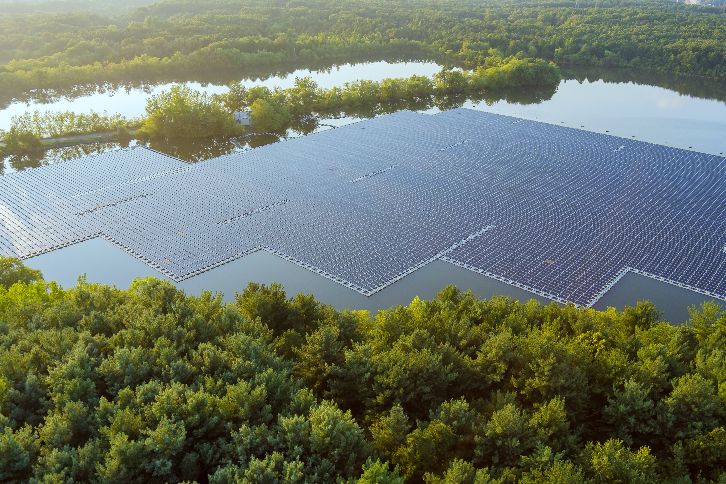
Floating photovoltaics uses the surface of important bodies of water to install floating photovoltaic panels.
Solar photovoltaic energy needs almost no introduction. It basically uses solar radiation to produce electricity. To do this, it requires three elements: photovoltaic modules, which convert photons of light into electrical energy; inverters, which convert direct current into alternating current and thus into electricity for consumption; and transformers, which raise the voltage to reduce electrical losses. In detail, the photovoltaic inverter has the function of converting the direct current, which is produced by the solar panels, into alternating current, which we can use. This transformation is achieved by means of power electronics devices (transistors, thyristors, coils, capacitors, etc.) that manage to transform a linear current into a sinusoidal current in the same way that we use in our homes and businesses.
Historically, photovoltaic installations, whether grid-connected generation plants or for self-consumption, have been located in places where the weather was conducive to a good number of hours of sunshine per year and always on the ground or on rooftops. However, in this way, other very important resources were being discarded: marshes and reservoirs and, lastly, the sea. Thus, floating photovoltaics was born, which uses the surface of these important bodies of water to install floating photovoltaic panels.
According to the World Bank, floating solar power could double the existing installed capacity of solar power because there are more than 400,000 square kilometres of artificial water reservoirs, i.e., swamps, reservoirs and the like in the world.
This variant of solar PV is gaining momentum in Asia, especially in China (a total of 1.3 GWp) and with more than 85% deployed in East and Southeast Asia. One example is Singapore, which inaugurated a 60 MWp plant in June 2021 and has requested a study for another 140 MW. As far as Europe is concerned, the Netherlands already has several floating photovoltaic plants while, in the case of Spain, this initiative is particularly interesting because it is the European Union country with the most infrastructures of this type, be they reservoirs, dams or dams, specifically 1,225, according to the Inventory of Companies and Reservoirs of the Ministry of Agriculture, Fisheries and Food.
At Iberdrola, we have been innovating for decades, especially in terms of renewable energies, which is why we are also developing the implementation of various floating photovoltaic solar energy installations.
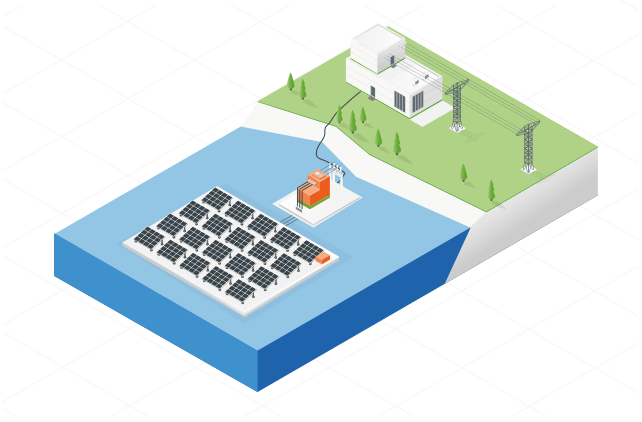
FLOATING PHOTOVOLTAIC:OPERATING DIAGRAM
Floating photovoltaic plant
- MV/HV booster substation
- Grid
- String invert / aggregation box
- Flotation system
- Photovoltaic modules
- LV/MV power block
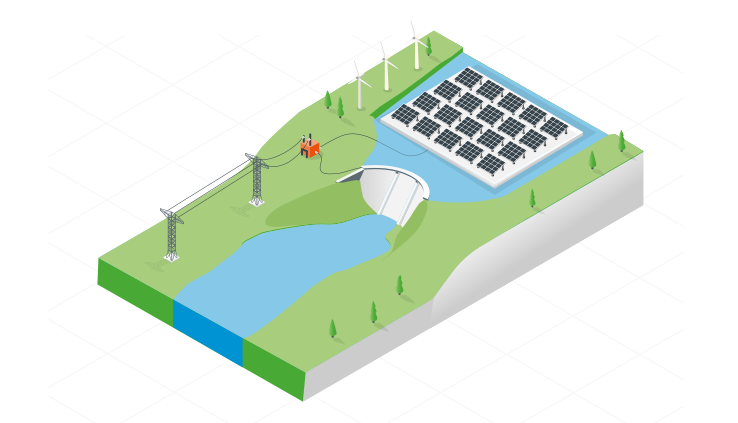
Floating photovoltaic on hydroelectric power plant
- Photovoltaic modules
- Flotation system
- Dam
- Grid
- MV/HV booster substation
HOW DOES A FLOATING PHOTOVOLTAIC PLANT WORK?
Floating PV plants have many similarities with traditional PV plants, but also some differences, especially with regard to anchoring, the flotation system and the evacuation of energy from the plant.
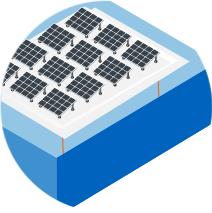
Floating photovoltaic modules are generally the same as those installed on land and are usually bifacial since this type, being dual glass, provides better protection against humidity and corrosion. As for the electrical system, barge-type structures with high buoyancy are being developed, which are used both for inverters and even for transformers. The same is true for cables, where major innovative solutions are being developed for floating solutions.
In terms of the floating system, there are essentially four types, although innovation is beginning to move towards mixed types. These four models are as follows:
- Pure: In these systems, the PV panels are located above the flotation system. In these systems, it is important to calculate the maximum tilt angle to compensate for the increased cost of the anchoring systems due to the loads on the structure with the possible increase in production by optimising the tilt angle.
- Metallic: These have a steel structure supported by a floating system on which the photovoltaic panels are supported and, although they offer better cooling with an impact on production, the costs of floating systems can be higher.
- Membrane: In these systems, the modules rest directly on the membrane in contact with the water. In these systems, although the loads are lower, production can be penalised depending on the location of the plant.
- Other systems: Systems with alternative materials, usually composed of iron and concrete, currently with a lower level of implementation.
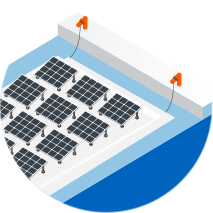
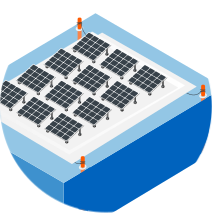
And finally, the anchoring systems, one of the keys to photovoltaic solar energy and fundamental to keeping the platform in position. In this aspect, the first thing to do is to carry out a bathymetry survey, i.e., a topographical study of the seabed, as this is not usually regular. In addition, it is also important to bear in mind that the installation must be allowed to have certain movements as well as taking into account that in a reservoir the water level and depth vary greatly, so the anchoring design must take this into account. The three most common types of anchorages are:
- Anchoring at the bottom
- Anchoring on the shore
- Piles
Mooring and anchors
ADVANTAGES AND DISADVANTAGES OF FLOATING PHOTOVOLTAICS
In addition, floating photovoltaics also has a number of advantages over traditional solar photovoltaics, which are:

Protects the water body from high evaporation and saves water.

Especially in summer, these installations protect against excessive algae growth by reducing eutrophication.


Floating photovoltaics prevent the strongest gusts of wind from eroding the shores.

- Positive factors: usually better cooling leading to increased production.
- Negative factors: limited tilt of current float models which, depending on location, can have a significant effect on production.
As for the disadvantages of this type of solar photovoltaic energy, most of them have to do with the fact that the technology is not yet fully developed and there is still little experience with this type of installation, making it a major challenge to be faced. These disadvantages can be summarised in three:
- Maintenance operations may be more complicated and require divers and there is uncertainty about their costs.
- Investment costs are currently higher than for ground-based PV.