COURTESY : www.unido.org
ENERGY MANAGEMENT
Energy Management Standards constitute a demonstrated effective policy tool and market-based mechanism to bring about sustainable energy efficiency in industry. National and international experiences have shown that even when cost-effective energy efficiency projects are identified by plant engineers they frequently experience difficulty in getting implemented. This is primarily a consequence of the top management focus on production rather than energy efficiency and the existence of a budgetary disconnect between capital projects and operating expenses. Experience has also shown that the sustainability of energy efficient practices is a challenge in industry: most optimized systems lose their initial efficiency gains over time due to personnel and production changes. The same factors that make it so challenging to achieve and sustain energy efficiency in industrial energy systems (complexity, frequent operating changes) apply to the production processes that they support.
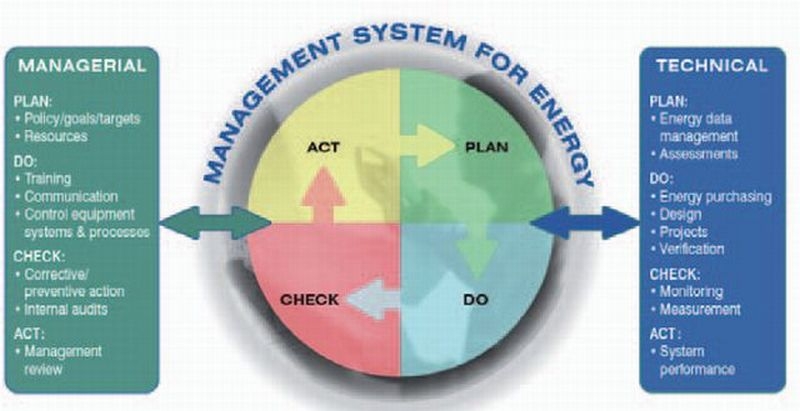
Using the well-known “plan-do-check-act” approach of worldwide adopted management system standards for quality and environment such as ISO 9001 and ISO14001, energy management standards provide structured and comprehensive guidance, primarily to industrial facilities, on how to integrate energy efficiency and system optimization into their daily management. Energy management standards establish closer linkages between business practices for the management of energy and core industry values of cost reduction, increased productivity, environmental compliance and global competitiveness. The UNIDO IEE programme assists developing countries and emerging economies by providing policymaking technical assistance, institutional capacity-building and market transformation support instrumental to the adoption and implementation in industry of energy management standards.